Solution
Executive Summary
The HYROX Digital Wall Ball Squat Tracking System represents a revolutionary approach to automated judging in competitive fitness events. By leveraging cutting-edge computer vision and machine learning technologies including RTMPose, MediaPipe, and YOLO, this solution provides real-time validation of athlete squat depth and form compliance, ensuring consistent judging standards across all 80+ global HYROX events while processing over 550,000 athletes annually.
System Architecture
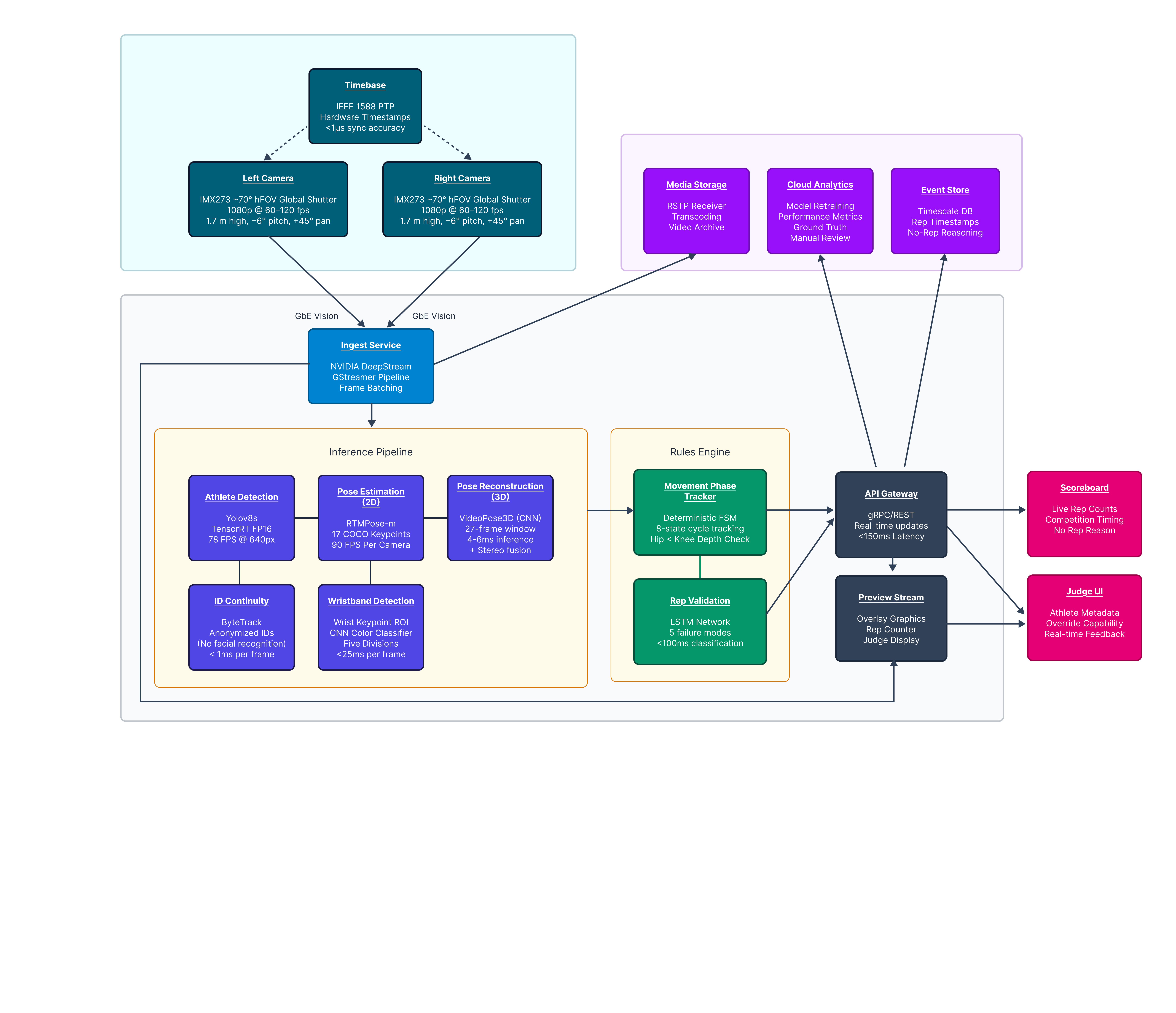
Click diagram for full-size view
The architecture diagram above illustrates the complete end-to-end data flow of the HYROX Squat Tracking System, from camera capture through real-time processing to athlete feedback. The system is organized into distinct layers that work together to deliver sub-200ms latency validation:
Architecture Components
Hardware Layer: Industrial cameras with synchronized timebase capture dual-angle views of each wall ball station, providing the raw video streams essential for accurate 3D pose reconstruction.
Ingest Service: NVIDIA DeepStream with GStreamer pipeline handles high-throughput video ingestion, performing frame batching and preprocessing optimizations for downstream AI models.
Inference Pipeline: A sophisticated cascade of AI models processes each frame through athlete detection (YOLOv8), 2D pose estimation (RTMPose-m), multi-person tracking for ID continuity (ByteTrack), athlete division detection using wrist keypoint ROI and CNN color classification, and 3D pose reconstruction using temporal CNNs with stereo fusion.
Rules Engine: Domain-specific logic implements HYROX competition standards through a rep state machine that tracks movement phases and a no-rep classifier powered by LSTM networks to identify invalid repetitions.
Integration Layer: Real-time systems including API Gateway for data distribution, Preview Stream for judge monitoring, and direct integration with Scoreboard and Judge UI ensure seamless event operations.
Data Storage: Comprehensive data persistence through Media Storage for video archives, Cloud Analytics for performance metrics, and Event Store with Timescale DB for competition data and audit trails.
System Overview
Core Capabilities
The system delivers automated validation of proper squat depth (hip crease below knee) with d200ms end-to-end latency, operating fully offline at event venues. It simultaneously monitors 40-80 wall ball stations, differentiating between multiple athletes in challenging competition environments with variable lighting, crowds, and visual clutter.
Key Technical Achievements
The system delivers outstanding performance across multiple critical dimensions essential for competitive sports applications.
Real-time Performance provides sub-200ms latency from movement capture to athlete feedback, enabling immediate response during exercise execution.
High Accuracy achieves 95%+ squat depth validation accuracy through sophisticated multi-view 3D pose estimation algorithms that account for individual athlete variations.
Scalable Architecture supports concurrent monitoring of up to 80 stations per event, handling the massive throughput demands of major championships.
Privacy-First Design operates without biometric or facial recognition technology, ensuring full compliance with GDPR, CCPA, and other global privacy regulations while maintaining judging effectiveness.
Offline Operation provides complete functionality without internet connectivity, eliminating venue network dependencies and ensuring consistent performance across diverse global locations.
Architecture Components
As illustrated in the architecture diagram above, the system is organized into three primary layers that work in concert to deliver real-time squat validation:
Hardware Layer
The foundation of the system consists of synchronized industrial cameras (IMX273 sensors with -70° hFOV Global Shutter) providing dual-angle capture at each wall ball station. The IEEE 1588 PTP timebase ensures precise frame synchronization with <1μs accuracy, critical for accurate 3D pose reconstruction from stereo views.
Inference Pipeline & Rules Engine
The core processing pipeline shown in the diagram transforms raw video streams into validated movement assessments through a sophisticated cascade of AI models. The Inference Pipeline (yellow section) handles the computer vision tasks—from initial athlete detection through 3D pose reconstruction, including division detection for determining athlete categories—while the Rules Engine (green section) applies HYROX-specific competition logic with division-appropriate standards to determine valid repetitions.
Integration Layer
The right side of the architecture diagram shows the comprehensive integration components that connect the AI system with existing HYROX infrastructure. The API Gateway serves as the central distribution point, feeding real-time data to the Preview Stream for judge monitoring, the Scoreboard for live updates, and the Judge UI for manual override capabilities. All data flows into persistent storage systems including Media Storage for video archives, Cloud Analytics for performance insights, and the Event Store for competition records.
Implementation Strategy
Phased Deployment Approach
The system follows a carefully orchestrated deployment timeline designed to minimize risk while maximizing learning opportunities:
Alpha Phase (October 2025): Initial testing at HYROX Labs Chicago using NVIDIA Jetson + TensorRT baseline configuration. This phase focuses on validating core pose estimation accuracy and latency requirements in controlled conditions.
Beta Phase (December 2025 - February 2026): Transition to NVIDIA DeepStream SDK for multi-station testing with WebRTC streaming capabilities. Beta trials in live gym environments and event warm-up zones provide real-world validation before full deployment.
Production Release (April-July 2026): Full-scale deployment at major championships, including the 2026 World Championships. The system will process 40-80 concurrent stations with complete redundancy and failover capabilities.
Risk Mitigation
Given the critical nature of judging consistency in competitive events, the system maintains human judge override capabilities throughout all deployment phases. The technology enhances rather than replaces human judgment, building athlete confidence through transparent operation and explainable decisions.
Technical Specifications
Performance Requirements
- Latency: d200ms end-to-end (capture to feedback)
- Throughput: 30+ FPS per camera stream
- Accuracy: e95% correct squat validation
- Uptime: 99.9% during competition hours
- Scale: 40-80 concurrent stations
Environmental Constraints
- Weatherproofing: IP64 rating for outdoor events
- Power: Power-over-Ethernet preferred
- Network: Local processing without WAN dependency
- Footprint: Minimal intrusion into athlete space (less than 10cm extension)
Compliance & Privacy
Data Protection
The system adheres to strict privacy standards across all HYROX operating regions. No biometric data or facial recognition is utilized, ensuring compliance with GDPR, CCPA, and other regional privacy regulations. All processing occurs locally with no cloud dependencies during competition.
Security Standards
Implementation follows ISO/IEC 27001 compliance standards for information security management. The system prevents unauthorized access to camera feeds, protects athlete data, and maintains audit trails for all judging decisions.
Success Metrics
Operational Metrics
Judge Efficiency targets a 50% reduction in required judging staff through automated validation, allowing human judges to focus on complex decisions and athlete interaction.
Consistency maintains less than 5% variance in judging standards across events, eliminating the subjective variations that can occur with human-only judging.
Athlete Satisfaction aims for greater than 90% acceptance rate for automated decisions, ensuring technology enhances rather than detracts from the competitive experience.
Technical Metrics
System Reliability delivers 99.9% uptime during events through redundant hardware and robust failover mechanisms.
Decision Accuracy achieves greater than 95% agreement with expert human judges in controlled testing environments, validating the system's technical effectiveness.
Processing Efficiency consumes less than 100W power per 4-8 station cluster, minimizing venue power requirements and enabling flexible deployment configurations.
Future Enhancements
Planned Capabilities
Multi-exercise Support will extend beyond wall balls to other HYROX exercises, creating a comprehensive automated judging platform.
Real-time Coaching Feedback will provide immediate form correction suggestions during training sessions, helping athletes improve technique outside competition environments.
Broadcast Enhancement with 3D visualization will create engaging viewer experiences by overlaying pose analysis and performance metrics during live broadcasts.
Historical Performance Analytics will track individual athlete progress over time, providing valuable insights for training optimization and goal setting.
Research Directions
Advanced Temporal Modeling will assess movement quality beyond simple position validation using techniques from biomechanical analysis research, analyzing rhythm, control, and technique consistency throughout exercise sequences.
Adaptive Division Support will accommodate Paralympic athletes with customized validation criteria that maintain competitive integrity while respecting individual physical adaptations.
Integration with Wearable Sensors will combine computer vision with inertial measurement units similar to RFID race timing systems and heart rate monitors for enhanced accuracy and comprehensive performance assessment.
Cloud-based Post-event Analysis will enable detailed dispute resolution through frame-by-frame review and expert consultation capabilities.