The Wall Ball Exercise
The wall ball combines a weighted squat with an explosive throw, testing both lower body strength and cardiovascular endurance. According to the HYROX Rulebook, athletes hold a medicine ball (weighing 4kg/9lbs for women, 6kg/14lbs for men in Open division; 6kg/14lbs for women, 9kg/20lbs for men in Pro division) at chest level, perform a full-depth squat, then explosively stand while throwing the ball to hit a designated target on the wall. The target sits at 2.75 meters (9 feet) for women and 3 meters (10 feet) for men, requiring significant power generation through the entire kinetic chain.
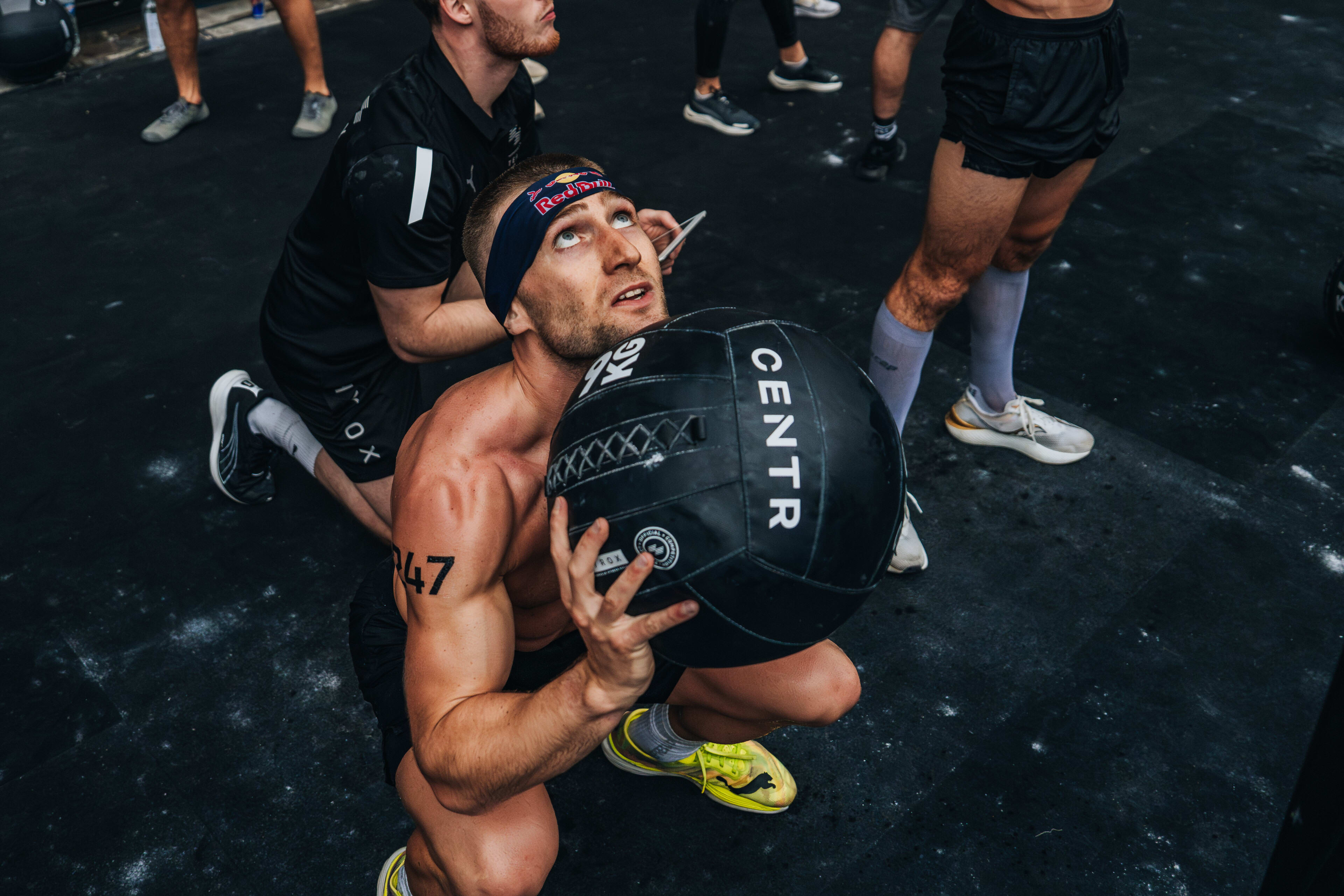 Standard wall ball movement pattern showing squat to explosive throw
Proper form demands precise execution of multiple standards that judges must evaluate in real-time. Athletes must begin each repetition "standing tall" with hips and knees fully extended while holding the ball at chest level. This starting position ensures consistent range of motion and prevents athletes from gaining advantage through partial movements. The squat phase demands that the athlete's hip crease descends below the knee joint—commonly called "breaking parallel" or achieving "below 90 degrees"—before initiating the upward drive.
 Official HYROX illustration showing required hip position below knee level
The throwing phase makes judging more complex than simple squat validation. After achieving proper depth, athletes must generate enough force to propel the ball above the target line while maintaining control throughout the movement. The ball must make clean contact with the wall above the designated height marker for the repetition to count. Athletes can either catch the ball on its descent for continuous repetitions or allow it to bounce once before beginning the next rep, but they cannot pick up the ball mid-bounce and continue without returning to the standing position.
Physical Setup
Competition zones have rows of wall ball stations arranged to fit as many athletes as possible while staying safe. Venues typically accommodate approximately 60 athletes simultaneously at the wall ball station, with larger events featuring up to 80 stations. Each station consists of a designated floor area approximately 2 meters wide by 3 meters deep, marked with tape or paint to define athlete boundaries. The wall target itself spans roughly 1 meter square, clearly marked with colored tape at the required heights. Digital displays mounted above each station show the current rep count, target number (ranging from 1-80 depending on venue size), and status indicators for judge validation.
Proper wall ball squat technique
HYROX currently uses Digital Wall Ball Targets with impact sensors, LED displays, and wireless connectivity to track successful ball hits. When the ball strikes above the target line with sufficient force, sensors register the impact and increment the rep counter. However, this system only validates the throw portion of the movement—judges must still visually confirm proper squat depth and starting position. This hybrid approach creates potential for inconsistency when human judgment varies between judges or when fatigue affects attention over long competition days.
Competition environments make judging much harder than ideal conditions suggest. Events typically feature 40-80 wall ball stations operating simultaneously, creating substantial background noise and visual distraction. Spectators crowd viewing areas, other athletes warm up nearby, and music pumps through venue speakers at high volume. Lighting conditions vary from bright stadium lights to darker corner positions, affecting visibility of anatomical landmarks judges use to assess squat depth. These challenging conditions contribute to judging inconsistencies that our computer vision system will address.
Judging Challenges
Human judges get overwhelmed trying to watch multiple things at once. For each repetition—and athletes must complete 100 reps in Open/Pro divisions (increased from 75 reps for Women's Open in earlier seasons)—judges must verify the starting position, track hip and knee angles during the squat, confirm the ball reaches target height, and maintain accurate rep counts. This becomes exponentially harder when monitoring multiple athletes at doubles or relay stations. As noted in HYROX training guides, "the judge watching can override this and give a 'no rep' if you haven't met the standard," requiring constant vigilance over extended periods. This mental load intensifies over 8-10 hour competition days, inevitably leading to attention lapses and inconsistent standards.
 Required starting position with full hip and knee extension
Different body types make standardized judging tough because the same angle looks different on different athletes. Differences in hip mobility, femur length, and torso proportions mean the same hip angle can appear vastly different across body types. An athlete with long femurs might achieve proper depth with a more upright torso, while someone with shorter legs might need to lean forward significantly. Judges must instantly process these variations while maintaining consistent standards, a task that becomes increasingly difficult as athlete volume grows.
Relay and doubles formats create chaos by putting multiple athletes at each station. During relay competitions, up to four athletes might occupy a single wall ball area, with non-competing team members positioned nearby for rapid transitions. According to HYROX competition rules, judges must identify which athlete is actively competing, ignore movements from resting teammates, and maintain accurate counts through frequent switches. The current system relies on colored wristbands to identify divisions (Open Men, Pro Men, Open Women, Pro Women, Adaptive), but these visual markers become difficult to distinguish in crowded, fast-moving environments. The official HYROX judges training emphasizes these challenges, requiring significant experience to manage multi-athlete stations effectively.
Current Limitations
Inconsistent judging frustrates athletes who get different standards between competitions or even between stations at the same event. Social media regularly features videos of athletes questioning judging decisions, comparing seemingly identical squats that received different verdicts. With events requiring 100-700 volunteer judges (including 40-80 specifically for wall ball stations), maintaining consistent standards across all officials becomes nearly impossible. This inconsistency undermines competitive integrity and discourages athletes from participating in future events. Post-event surveys indicate judging consistency ranks among the top three concerns for HYROX participants. The 2025 World Championships controversy highlighted these issues, with athletes reporting "judging inconsistencies during burpee broad jumps, sled transitions, and wall ball stations," leading to calls for professional judges and video review systems.
Finding and training judges slows down expansion as HYROX grows globally. Each event requires 40-80 qualified judges for wall ball stations alone, plus additional officials for other workout areas. Training these judges requires significant time investment, standardized curriculum development, and ongoing quality assurance. Smaller markets struggle to maintain adequate judge pools, while inconsistent training standards between regions create systematic variations in competition standards.
Manual counting wastes data opportunities that could improve athlete and spectator experience. Current judging provides only binary feedback (rep counts or doesn't count) without capturing performance metrics like squat depth angle, rep cadence, or power output. This missed opportunity prevents athletes from receiving technique feedback, limits broadcast graphics to basic rep counts, and eliminates possibilities for advanced analytics that could drive training improvements.
Why Automation Matters
Computer vision will deliver consistent standards that restore athlete confidence in fair competition. By analyzing precise joint angles and body positions, automated systems eliminate subjective interpretation and maintain identical criteria across all stations, events, and geographic regions. Athletes will know that achieving proper form guarantees rep validation, regardless of external factors that might influence human judgment.
Real-time feedback will change the athlete experience beyond basic rep counting. Our system can provide immediate visual or audio cues when athletes approach depth thresholds, helping them self-correct form during competition. This feedback loop not only ensures fair judging but actively helps athletes optimize their performance, turning the judging system from a passive validator into an active coaching tool.
Efficiency gains will let HYROX keep growing without hiring proportionally more staff. Reducing judge requirements from one per station to perhaps one per four stations for oversight dramatically simplifies event logistics. This efficiency translates directly to cost savings, faster event setup, and the ability to expand into markets where recruiting large judge pools would be prohibitive. The system pays for itself through reduced labor costs while delivering superior consistency and data capture capabilities.