Cameras
Camera Specs
The camera system will need precise motion capture in dynamic competition environments. These specs will ensure reliable performance across diverse lighting conditions while providing the image quality needed for accurate pose estimation (measuring body position) and depth measurement (distance calculations).
Sensor Requirements
The camera selection prioritizes consistent performance across varying light conditions typical of competition venues. Industrial-grade sensors with global shutter technology (captures the entire image at once) will prevent motion blur and distortion during rapid athlete movements. This is unlike rolling shutters that scan line by line, which can create distortions.
Recommended Specifications will balance performance requirements with deployment practicality for competition environments.
Sensor Technology will use IMX273 with C-mount configuration providing reliable industrial-grade performance under varying conditions.
Resolution and Frame Rate will deliver 1080p (1920×1080) capture at 60–120 fps, ensuring sufficient temporal resolution (time-based detail) for rapid movement analysis.
Global Shutter Technology will prevent motion artifacts (visual distortions) during fast athlete movements, while GigE Vision PoE+ Interface (network connection that also carries power) will simplify cabling through combined data and power delivery.
Field of View will achieve approximately 70° horizontal coverage through 5mm lens configuration, optimizing capture area while minimizing geometric distortion.
Wide dynamic range (WDR) sensors will handle extreme lighting contrasts between bright spotlights and shadowed areas, ensuring consistent image quality across the competition environment.
Optical Configuration
Lens selection will balance field of view requirements with geometric distortion minimization. The recommended 5mm C-mount lens will provide approximately 70° horizontal field of view, offering optimal coverage of the workout area while maintaining acceptable perspective distortion. Manual focus and aperture controls, once calibrated, will remain locked throughout the event to maintain consistent depth of field (focus range) and exposure characteristics.
Placement Strategy
Physical Configuration
Camera Positioning will follow precise geometric specifications to optimize 3D reconstruction accuracy (building 3D models from 2D images).
Height Placement will position both cameras at 1.7m above ground level, providing optimal viewing angles for squat depth analysis while avoiding athlete interference.
Pitch Angle will maintain -6° downward orientation to capture full athlete motion range from standing to deep squat positions.
Pan Orientation will center cameras at -45° midpoint between athlete positions, ensuring balanced coverage of both athletes in dual-station configurations.
Mounting Strategy will use front pylons exclusively (front-left and front-right corners), eliminating the need for rear-mounted equipment while maintaining sufficient parallax (viewing angle difference) for accurate triangulation (3D position calculation).
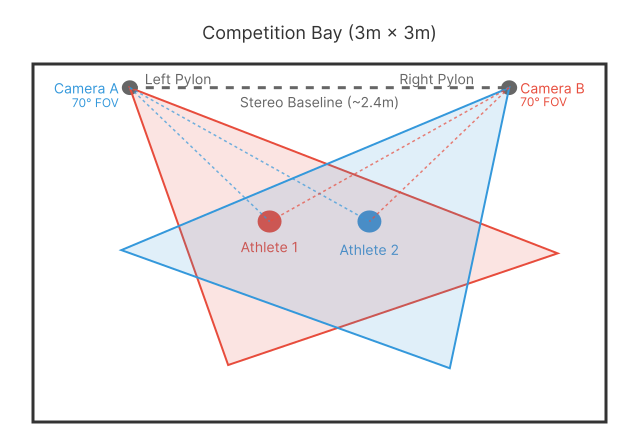
Camera Field of View Diagrams
Overhead View
Side View

Dual-Camera Geometry
The two-camera configuration will use strategic positioning on front pylons to achieve optimal stereo baseline (distance between cameras) for 3D reconstruction.
Both cameras will be mounted at identical 1.7m height on the front-left and front-right corner pylons, eliminating left/right bias between athletes. The horizontal separation will provide approximately 80-90° viewing angle difference for robust triangulation.
Geometric Calculations
For a competition bay with width W = 3.0m and depth D = 3.0m, with athletes positioned at (-0.75, 0) and (+0.75, 0), and cameras on front pylons at (-1.5, 1.5) and (+1.5, 1.5):
Azimuth angle (relative to athletes facing forward):
Viewing angles:
- Left camera to left athlete: ~27° (front-left oblique)
- Left camera to right athlete: ~56°
- Right camera to right athlete: ~27° (front-right oblique)
- Right camera to left athlete: ~56°
This configuration will provide ~83° stereo separation for each athlete, optimal for triangulation without requiring rear-mounted cameras.
Multi-Athlete Accommodation
When two athletes share a single bay, cameras will aim toward the midpoint between athlete positions. The oblique viewing angles (approximately 30-45 degrees off-axis) will ensure both athletes remain visible throughout their range of motion. This configuration will minimize mutual occlusion (one athlete blocking another) while maintaining sufficient parallax for accurate depth estimation of critical joint positions.
Environmental Adaptations
Lighting Compensation
Venue lighting may vary dramatically from bright television lighting to dim warehouse conditions. Cameras will use automatic gain control with limits to prevent noise amplification (graininess) in low light. Supplementary LED panels may be deployed for consistently dark venues, positioned to avoid direct glare while providing fill lighting for hip crease visibility. Locked exposure settings during competition will prevent brightness fluctuations from affecting pose estimation algorithms (software that identifies body positions).
Calibration Procedures
Intrinsic Calibration
Prior to each event, intrinsic camera parameters (internal camera settings) will be calibrated using ChArUco boards (calibration patterns) to model lens distortion characteristics. This process will capture radial and tangential distortion coefficients (measurements of lens warping) essential for accurate 3D reconstruction. Calibration data will remain valid unless focal length or focus distance changes, necessitating recalibration. The calibration process will take approximately 10 minutes per camera using automated capture and analysis software.
Extrinsic Calibration
Spatial relationships between cameras will be established through extrinsic calibration (positioning setup) using visible markers placed at known positions within the workout area. The process will determine rotation and translation matrices (mathematical descriptions of camera positions) relating each camera to a world coordinate system centered on the wall ball target. Multi-camera bundle adjustment (fine-tuning process) will refine these parameters for optimal reconstruction accuracy across the entire capture volume.
Synchronization Architecture
Hardware Triggering
Precise temporal alignment (timing coordination) between cameras will be critical for accurate 3D pose estimation. Hardware triggering will ensure simultaneous frame capture across all cameras, eliminating motion artifacts from temporal misalignment (timing differences). A master trigger signal, generated at 60Hz or 120Hz, will synchronize all cameras within microsecond precision. This approach will outperform software synchronization methods which suffer from variable system latencies (delays).
Timestamp Management
Each captured frame will receive high-precision timestamps at the moment of exposure, enabling accurate temporal correlation across the distributed system. Network Time Protocol (NTP) or Precision Time Protocol (PTP) (network time synchronization methods) will maintain clock synchronization across all system components. Timestamp accuracy within 1ms will ensure proper frame association for multi-view reconstruction algorithms.
Bill of Materials
Recommended Camera Models
Production deployments will use machine vision cameras such as FLIR Blackfly S series or Basler ace models with GigE Vision interfaces (industrial camera connections). These cameras will provide consistent performance, hardware triggering capabilities, and robust SDK support (software development tools). Alternative options include Intel RealSense D455 for integrated depth sensing or high-end webcams like Logitech Brio 4K for budget-conscious deployments.
Mounting Hardware
Adjustable camera mounts with quick-release mechanisms will facilitate rapid deployment and precise positioning. Ball head mounts will provide multi-axis adjustment, while safety cables will prevent accidental drops. Pylon clamps must accommodate varying pole diameters (50-100mm) with rubber padding to prevent slippage. Weather-resistant enclosures will add approximately 20% to camera dimensions and must be factored into placement calculations.
Mobile Device Integration
Modern smartphones like the iPhone will offer compelling alternatives to dedicated machine vision cameras for certain deployment scenarios. The iPhone's computational photography capabilities, including hardware-accelerated pose estimation via ARKit and CoreML (Apple's machine learning frameworks), will provide real-time processing that could reduce infrastructure requirements. However, dedicated industrial cameras will remain preferred for production deployments due to superior synchronization capabilities, environmental durability, and consistent performance under varying lighting conditions.