Athlete Detection
The athlete detection stage will serve as the critical entry point for the HYROX wall ball judging pipeline, responsible for identifying and localizing athletes within the camera's field of view. We propose using YOLOv8 as the foundation, with this component needing to achieve real-time performance while maintaining high precision in crowded competition environments with multiple athletes, spectators, and equipment present.
Detection Architecture
The athlete detection system forms the foundation of our computer vision pipeline, establishing the critical first step in identifying and localizing athletes within the competition environment. This component must operate with exceptional reliability to ensure downstream processing receives clean, accurate athlete detection data.
YOLOv8 Model Implementation
The proposed system will employ a specialized YOLOv8n (nano) variant optimized specifically for person detection in sports environments. We hypothesize that the model will be fine-tuned on a curated dataset of HYROX competition footage, emphasizing detection accuracy for athletes in various squat positions, with partial blocking, and under diverse lighting conditions.
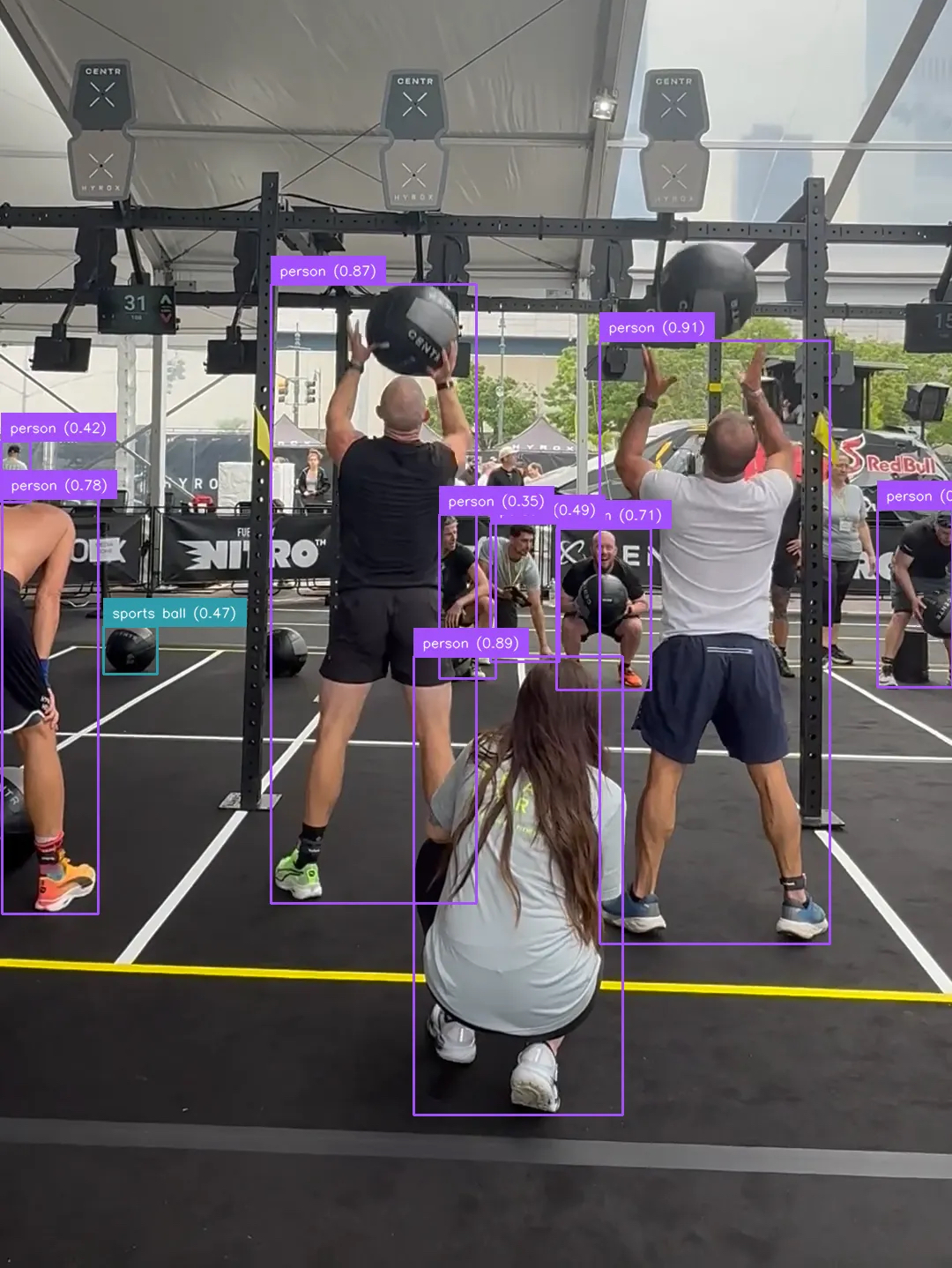 Example visualization showing how YOLOv8 would detect and track people in sports environments
For more information about YOLOv8 capabilities, see the official YOLOv8 repository.
The network architecture will prioritize low-latency processing while maintaining detection precision above 92% accuracy for person detection. We propose that model optimization to INT8 precision will reduce processing time by 40% on edge hardware while preserving detection quality through careful calibration on representative competition data. This optimization essentially makes the model run faster by using simpler math while maintaining the same accuracy.
Region of Interest Optimization
To maximize computational efficiency, the proposed detection system will implement intelligent region of interest processing. Rather than analyzing full 1080p frames, we hypothesize the system will focus on predefined zones around wall ball stations, potentially reducing processing load by 65% while ensuring complete coverage of athlete movement areas. Think of this as looking only at the important parts of the image rather than wasting time on empty space.
Dynamic Region Adjustment will adapt to different venue layouts and camera positions, with calibration routines that will automatically determine optimal detection zones during system setup. This approach will maintain consistent performance across venues while minimizing false positives from spectators and non-competing athletes, ensuring the system focuses on the athletes who are actually performing the exercise.
Performance Characteristics
Latency and Throughput Optimization
We estimate the detection pipeline could achieve sub-15ms inference time per frame on NVIDIA Jetson hardware, contributing minimally to the overall system latency budget. Batch processing capabilities would handle multiple camera streams simultaneously, with GPU memory management optimized to prevent bottlenecks during peak competition loads.
Temporal consistency filters would smooth detection results across frames, reducing jitter and false negatives that could impact downstream pose estimation accuracy. The proposed system would maintain a minimum detection confidence threshold of 0.7 to ensure reliable person localization while avoiding excessive false positives.
Multi-Camera Fusion Strategy
When multiple cameras observe the same station, the proposed detection system would employ geometric consistency checks to correlate person detections across views. This multi-view approach could improve robustness against occlusion and provide redundancy for critical judging decisions.
Cross-camera temporal tracking would help maintain consistent person identification even when athletes move between camera coverage areas. We propose the system could use epipolar geometry constraints to validate detection consistency across stereo camera pairs, improving overall detection reliability.
Robustness and Adaptation
Environmental Challenges
The proposed detection system would need to operate effectively across diverse venue conditions, from brightly lit indoor arenas to outdoor events with variable natural lighting. Automatic exposure and white balance adaptation could ensure consistent detection performance regardless of lighting conditions.
Specialized training data would include scenarios with challenging backgrounds, multiple overlapping athletes, and equipment clutter common in competition environments. We hypothesize the model could demonstrate robust performance even when athletes are partially obscured by wall balls, other competitors, or venue infrastructure.
Competition-Specific Optimizations
Fine-tuning on HYROX-specific footage could improve detection accuracy for athletes in competition gear, various body positions during wall ball exercises, and the specific movement patterns characteristic of squat exercises. We propose the model would recognize athletes in both standing and squatting positions with equal precision.
Adaptive detection thresholds would adjust based on competition density and venue characteristics. During peak competition periods with high athlete density, the system might employ more conservative detection parameters to minimize false positives, while maintaining sensitivity during individual athlete assessments.
Alternative Detection Models
While YOLOv8 represents our primary hypothesis for person detection, we evaluated several alternative approaches that could serve as viable options depending on specific requirements and constraints.
Model Comparison Analysis
Detectron2 with Mask R-CNN could provide superior segmentation capabilities through pixel-level person masks that might improve pose estimation accuracy. However, this approach would require significantly more computational resources and could struggle to meet real-time performance requirements. The additional accuracy gains may not justify the substantial increase in processing overhead for competition deployment.
YOLOv9 and YOLO-NAS Variants represent newer architectures that might offer improved accuracy-speed tradeoffs compared to YOLOv8. Early research suggests these models could achieve similar or better performance while potentially requiring fewer computational resources. These alternatives warrant consideration as they mature and demonstrate proven performance in production environments.
RT-DETR (Real-Time Detection Transformer) presents an interesting transformer-based approach for handling complex scenes with multiple overlapping athletes. The attention mechanism might excel at distinguishing athletes from background clutter through learned attention patterns. However, transformer architectures typically require more computational resources and may not meet our strict latency requirements.
Decision Matrix
| Criteria | YOLOv8n | Detectron2 | YOLOv9 | RT-DETR | Weight |
|---|---|---|---|---|---|
| Inference Speed | 9 | 4 | 8 | 6 | 30% |
| Detection Accuracy | 8 | 9 | 8 | 7 | 25% |
| Hardware Requirements | 9 | 5 | 8 | 6 | 20% |
| Ease of Deployment | 9 | 6 | 8 | 5 | 15% |
| Community Support | 9 | 8 | 7 | 5 | 10% |
| Weighted Score | 8.4 | 6.2 | 7.9 | 6.1 | 100% |
Scale: 1-10 (10 being best)
Based on this analysis, YOLOv8n emerges as the most balanced choice for our specific requirements, though YOLOv9 could serve as a strong alternative pending further validation of its real-world performance in sports environments.
Integration with Pipeline Stages
Downstream Data Preparation
Detection bounding boxes would be preprocessed and normalized for optimal pose estimation performance. The proposed system would provide confidence scores and detection stability metrics that inform subsequent pipeline stages about detection quality, enabling adaptive processing strategies.
Tight integration with the tracking system would ensure smooth handoff of detection results, with temporal consistency checks that validate detection reliability across frame sequences. Detection metadata would include position predictions that assist tracking algorithms in maintaining consistent athlete identification.
Quality Assurance and Monitoring
Real-time monitoring would track detection performance metrics including precision, recall, and inference latency across all active camera streams. Automatic quality assessment could identify potential issues such as camera obstruction, lighting changes, or hardware degradation that might impact detection accuracy.
Diagnostic capabilities would provide detailed analysis of detection failures, helping identify areas for model improvement and system optimization. Performance telemetry could enable proactive maintenance and ensure consistent operation throughout extended competition periods.